If you want free publicity for your blog (and who wouldn’t?), check out OpTempo’s self-interview form. Just fill out the questionnaire and, subject to approval, the interview about your blog will appear on OpTempo.
Once upon a time, free blog reviews also were available but those are no longer offered. If you look at previous reviews, however, you’ll see that OpTempo owner Frank Carr took the review process seriously and did a thorough job. You might want to look through some of the recommendations he made to see if any apply to your blog.
If you want to get motivated to use your blog for selling, let these sales motivation quotes inspire you!
More free promotion
Promote your blog by getting it listed in the human-reviewed Blog Collection. When you join, all subsequent members will include your URL in their blogrolls. To apply, go to The Blog Collection.
Elvis is Alive Museum sells on eBay
* 81-year-old Baptist minister Bill Beeny sold the entire collection from his Elvis Is Alive Museum on eBay for $8,300. The collection includes a recording of The King’s voice that was supposedly made long after his death, and the casket and gravestone from his 1977 funeral. Beeny’s son Steve said his father would have liked the collection to stay in the family, but all his brothers and sisters â€have real lives.â€
What a gentleman
* A 70-year-old man in Erie, Pennsylvania tried to solve his financial problems by robbing a bank. When police found him based on his description, he immediately apologized to them and asked to apologize to the teller. You just don’t see manners like that any more.
It’s not such a small world after all
* It might be that we’re all getting heavier. Consider the situation at Disneyland, where they plan to close the 41-year-old “It’s a Small World†ride in January to, among other things, deepen the canals that carry the boats. It seems the boats have been getting stuck at two places in the ride, causing employees to ask volunteers to get out to lighten the load. Some might blame it on the layers of fiberglass used to patch the canals over the years, but it’s awfully telling that Disney has also upped the largest uniform size they carry.
The Elements of Style manages to condense all the important rules of grammar into a package so small, you could mistake it for a drink coaster. Well, maybe it’s not that small. But small enough to give the impression that it wouldn’t cover enough territory to be worth buying. But it does and it is. That’s why writers have loved it since it was published for mass distribution in 1959.
When Professor William Strunk self-published the original version in 1919, it was even smaller than it is today. E.B. White (of Charlotte’s Web fame) was a student in Strunk’s Cornell University English class at the time, so he had to read The Elements of Style along with the rest of his classmates. After graduating, he promptly forgot about the book. He couldn’t have known then that 38 years later Macmillan would ask him to revise it for the college market and general trade.
A master of economical writing, White used not one word more than was necessary to spruce up Strunk’s original take on grammatical style. And that’s exactly the point of the book; it advocates a lean economy. Thankfully, it also allows for flexibility. The book still counsels to omit needless words and to use concrete, specific language instead of the abstract, but it also gives advice on using colloquialisms and avoiding fancy words. And the glossary alone is worth the price of admission. Especially for those of us (ahem) who can’t seem to remember the names of all the parts of speech.
The book covers a vast array of grammar questions, although White insists in his forward that The Elements of Style isn’t meant to be comprehensive. The topics it covers are too numerous to mention, but here are some:
Commonly misused words and expressions
Nouns used as verbs
Writing in a way that comes naturally to you
Not taking shortcuts at the cost of clarity
The number of the subject determines the number of the verb
White’s plainspoken authority intimidated me when I first read the book years ago. It helped me relax, though, when I read the forward in the fourth edition by White’s stepson, Roger Angell. He tells of observing White’s weekly efforts to come up with copy for the “Notes and Comments” page of The New Yorker. Angell said that sometimes after the copy was in the mail from Maine to New York, White would say, “It isn’t good enough. I wish it were better.” Experiencing this fundamental anxiety writers are prone to led him to infuse The Elements of Style with practical, no-nonsense advice. He probably even needed the reminders himself.
Although White died in 1985, his little book is still among a writer’s best friends. This is due in no small part to his understanding of a wordsmith’s plight.
We hope you enjoyed this book review on The Elements of Style. You might also want to read our other book reviews:
But of course you can. This is an example of another worn-out rule that needs to be debunked. I don’t even know how this one began, because people have been beginning sentences that way since the 10th century.
One caveat: even people who support the use of and and but to begin sentences believe that overuseleads to monotony. But what is overuse? Personally, I never begin a sentence with and and but more than once each in a paragraph. It’s my experience that more frequent use gives the writing a droning quality. And if I can go several paragraphs without using them in that way, so much the better. When used properly, however, beginning sentences with and and but can actually introduce a continuity and colloquial feeling to your writing.
Also, see grammar myth #1: You can’t end a sentence with a preposition.
You might also be interested in these related posts:
November 7th, 2007 carlajc Posted in Contest, Photography | Comments Off on Photo and Short Story Contest
We’re in the process of creating a photo and short story contest, in conjunction with 99 Bloggers. Stay tuned or leave a comment now that you’re interested and we’ll get back to you when all the details are in place.
In the meantime, please visit 99 Bloggers, the new soapbox for bloggers that provides high quality, informative content!
It’s not enough to have your site or blog to rank well; it has to place highly for words that are closely related to your Web site or blog content. This is where an important part of search engine optimization comes in: keyword analysis, the art and science of identifying keywords that describe the focus of your Web property and are popular with the public. People who overlook this critical element usually have sites or blogs that don’t rank in search engines at all. If they do rank, they frequently do so for keywords that no one is looking for.
For example, if a broker sells condos in the Buford suburb of Northeast Atlanta and her Web site is “GreatSouthernCondos.com,” the search engines probably would rank the site well for the search term “great southern condos.” This is because those words are in her site name and there is very little competition for that exact phrase. But that wouldn’t help her much, because it’s doubtful anyone would search for those exact words. A Web site that ranks highly for search terms that no one is looking for might as well be invisible.
All keywords are not created equal
To allow the largest number of people to find her site, the agent’s keywords must be specific. She could try using the search term “Atlanta Georgia Real Estate,” which is somewhat specific and has an average of 130,000 people, per engine, searching for that phrase every month. But a search for “Atlanta Georgia Real Estate” in a major search engine also reveals that over five million sites are competing with hers.
This is why good keyword analysis is important. People clamor to learn how to make money online, but most fail because they don’t understand that it’s essential to find search terms that accurately describe their businesses, are frequently searched by the public and don’t have too many competing Web sites. For example, if you found a keyword that had several thousand or more people searching for it, and the competing Web sites numbered two million or less, your site probably would rank very well. This is not to say that your site wouldn’t rank well if the number of competing Web sites were greater than two million; in fact it’s quite possible. But to do so, your site would have to have all aspects of Web optimization executed perfectly.
Since the number of key phrases anyone can use on a site before diluting their effectiveness in the search engines is limited, it’s critical to focus on words that give you the most impact. But here’s where it gets confusing: even search terms that are quite specific to your business can be duds. You might think featuring the phrases “Buford Georgia real estate” or “Buford Georgia condos” on “GreatSouthernCondos.com” would help the site rank highly when people search for condos in Buford. But you’d probably be surprised to know that virtually no one is searching for either of those terms. So, although it’s important to be specific with your keywords so you differentiate your site, again, if no one is actually searching for the terms you have on your site, it still won’t be found.
To analyze your keywords, you’ll need two tools: a keyword finder program, such as Wordtracker, and any major search engine. (Click here for a list of the major search engines.) Wordtracker will display which keywords are being searched for most frequently. As discussed above, without this information, everything you assume about what people are looking for would be a guess at best.
Once you’ve found keywords that are both relevant to your site and have a significant number of people searching for them, you can use the search engine to find out how many sites are competing with yours. Simply enter the final keywords you’ve chosen into the engine, one word or phrase at a time, to see how many sites come up under each term.
If you decide that the research is too much work for you, however, you can hire a keyword analyst. If you do, there are several ways you can help him help you:
Think about the elements that differentiate you from competitors. If you sell real estate, do you specialize in mountain-view, resort or historical properties, or even all three? If you’re a mortgage broker, do you specialize in hard-to-fund loans? If you’re an appraiser or a home inspector, do you have areas of specialization? You know your business better than anyone, so make a list of any words and phrases that might indicate how your business differs from others in your category. Although the keyword analyst is trained to track down the best words for your site, providing many options for him to search can make the results even more powerful.
Introduce your keyword analyst to the person promoting your site to the search engines. Usually, one party does both keyword analysis and Web promotion. But some Web promoters don’t focus on analyzing keywords. So, if you already have a Web promoter and you hire a separate keyword analyst, make sure the two parties are willing to work together for your benefit. If you haven’t hired a company to optimize and promote your site yet, someone who does both analysis and Web promoting would be a good choice.
Whether you do the keyword analysis yourself or hire someone, it should be done. This applies even if you’ve had your site for a long time. Since the search engines renew their listings all the time, it’s never too late to get better rankings.
To learn how to avoid some critical mistakes people make when implementing search engine optimization strategies, click here.
Article by Dave Schloss, who specializes in keyword analysis and Web site promotion, and is the founder of Super Web Site Promotion.
Just this morning there was a cautionary tale in the news about an Atlanta man’s e-mail to a woman who rejected him on Match.com. In an attempt to persuade this woman that she was missing out on a hot catch, he enumerated his many charms, including that he “has an 8.9 rating on HotOrNot.com, drives a Beemer, can bench press over 1,200 pounds and has had lunch with the secretary of defense.â€
His e-mail made the rounds on the Internet until it found its way to the Atlanta Journal-Constitution, where I read the story. But the guy didn’t just embarrass himself in Georgia. His rant also was featured on gossip Web site Gawker.com. The story generated 285,000 Gawker.com page views and over 3,000 online comments, most of them negative. That’s a great argument for thinking before you click the Send button.
The concept of thinking before you launch your words into cyberspace permeates Send: The Essential Guide to Email for Office and Home This compact but powerful book covers diverse aspects of modern communication, including:
When you should substitute a fax, letter, instant message or phone call for an e-mail
How to apologize for an inexcusably late e-mail reply
The politics of Cc and Bcc
Flame wars
How men and women use e-mail differently
Every aspect of electronic communication seems to be covered in this handbook, which was written by two seasoned professionals: David Shipley, Op-Ed page editor of the New York Times and Will Schwalbe, senior vice president and editor in chief of Hyperion books. They write with wit and style, which makes taking our medicine almost fun. They’ve also infused the book with an understanding of the human condition behind our communications, making Send oddly comforting.
We hope you enjoyed this book review of Send: The Essential Guide to Email for Office and Home. You might also want to read our other book reviews:
Maybe it’s because I was born in the San Fernando Valley, home of the Valley Girl, that I don’t really care for the word awesome. I’m not sure whether Moon Zappa used it or not, but it seems very much like a Valley word to me. And I didn’t move all the way from California to the East Coast because I liked the Valley.
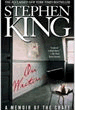
That’s probably more information than you need to know about me, but I wrote it for a reason. I want you to know there has to be a special reason for me to call anything awesome. So, with that explanation out of the way, here’s my assessment of Stephen King’s On Writing: it’s awesome.
Part memoir and part writing primer, this book is a must-read for anyone who writes — or reads, for that matter. King’s life story, which takes up the first half of the book, would be interesting even if the prose weren’t well written. But it is, and his accessible writing style elevates the material even more.
As interesting as the first half is, the second half is the reason I’m writing this review. Full of tips for writers, On Writing not only educates; it inspires. King obviously loves the craft of writing, and not just for the enormous amount of money it has earned him. In this book he honestly lays bare his own creative process, which happened to incorporate a life-threatening car crash and the struggle to came back to productivity again. He then goes on to hand out excellent common sense advice and practical tips for writers, along with sincere encouragement.
So if you ever feel your creative gas tank getting low, I highly recommend this awesome little book. If you’re like me, you’ll walk away inspired.
We hope you enjoyed this book review of On Writing. You might also want to read our other book reviews:
Stock.Xchng makes it easy to add free images to your blog or Web site
If you want to improve your blog or Web site by adding photos and don’t want to spend a dime to do it, Stock.Xchng, located at www.sxc.hu, is a great resource. I’ve found many quality free photos there over the years, including the cut newspaper letters you see incorporated into the header of this blog, and most of the photos on the pages.
Free images from the Stock.Xchng site may be used in any of the following ways:
In digital format on Web sites, multimedia presentations, broadcast film and video, and cell phones
In printed promotional materials, magazines, newspapers, books, brochures, fliers and CD/DVD covers
Along with your corporate identity (but not as your company logo) on business cards, letterhead, etc.
To decorate your home or office
If you’re going to use a free photo from the site, all Stock.Xchng asks is that you leave a comment for the photographer, telling him how you plan to use the image. (You might also want to write a compliment to encourage him to post more photos in the future.) There are a few additional conditions if you want to use images for purposes other than in the above list, but those are clearly spelled out on the standard restrictions page. Also, be aware that a few photographers have their own sets of restrictions. But these are posted under the preview images of their photos, so you’ll know about the requirements before you download.
The Stock.Xchng site also offers an extensive collection of member-written tutorials and blogs on photography and graphic manipulation. They cover topics such as using a scanner to generate photographic images, “drawing†with light, repairing images made from torn printed photos, and many others. If you’re interested in photography or graphics, their large collection of user-generated information alone is worth a trip to their Web site.
Sample Stock.Xchng free image by John Nyberg
You might also be interested in these other resources on WordPlay:
Some words just beg to be spelled wrong or otherwise abused. Here are some of them:
Common misspellings (The bold words are spelled correctly.)
accommodate
Don’t you just want to take out that extra “c”?
a lot
A lot of the time, you see this written as “alot,” which it’s not.
cemetery
I’ve misspelled this with an “a” replacing the third “e” more times than I want to admit.
easement
I tend to want to ease out that second “e” and make it “easment” but that would be incorrect.
fiery
What a strange spelling to indicate something that’s on fire. This word seems more suited to a mythical forest creature than to indicate the hot nature of one of the planet’s basic elements.
foreclosure
Here’s another example of a word with an “e” (after “for”) that gets left off a lot of the time.
gauge
I always have to look twice at this word to make sure I’m not confusing it with gouge.
judgment
Unlike “easement” and “foreclosure,” the proper American form of this word doesn’t contain an “e.” If the writer is British, however, chances are you will find the “e” in place, making “judgement” an acceptable spelling.
liaison
You can blame this one on the people who lived in France about 400 years ago. We’ve had to live with that extra “i” ever since.
misspell
This one has always bothered me. It’s not that the spelling doesn’t make sense, it does. It’s just that it looks funny to me. Other people must agree because it is often misspelled.
occurrence
Not only does it have two pesky double consonants, but every time I spell it, I want to replace that last “e” with an “a.”
perseverance
So many people pronounce this purs-er-veer-ance, it’s easy to think it has a third “r.”
supersede
If precede is spelled with a “c” and means “to go before,” then why would supersede, which means “to take the place of,” be spelled with an “s”? I have no idea. They both indicate movement and would seem to be related.
words with “or” instead of “er”: lessor, grantor, mortgagor
There are many words that seem like they should end in “er” but instead terminate in “or.” In some cases, such as in “lessor,”swapping the “or” for an “er” (“lesser”) changes the meaning entirely.
You might also be interested in these related posts:


 OpTempo offers free interviews and 125×125 ads


 But of course you can. This is an example of another worn-out rule that needs to be debunked. I don’t even know how this one began, because people have been beginning sentences that way since the 10th century.
 It’s not enough to have your site or blog to rank well; it has to place highly for words that are closely related to your Web site or blog content. This is where an important part of search engine optimization comes in: keyword analysis, the art and science of identifying keywords that describe the focus of your Web property and are popular with the public. People who overlook this critical element usually have sites or blogs that don’t rank in search engines at all. If they do rank, they frequently do so for keywords that no one is looking for.
 Just this morning there was a cautionary tale in the news about an Atlanta man’s e-mail to a woman who rejected him on Match.com. In an attempt to persuade this woman that she was missing out on a hot catch, he enumerated his many charms, including that he “has an 8.9 rating on HotOrNot.com, drives a Beemer, can bench press over 1,200 pounds and has had lunch with the secretary of defense.â€
 This compact but powerful book covers diverse aspects of modern communication, including:
 Maybe it’s because I was born in the San Fernando Valley, home of the Valley Girl, that I don’t really care for the word awesome. I’m not sure whether Moon Zappa used it or not, but it seems very much like a Valley word to me. And I didn’t move all the way from California to the East Coast because I liked the Valley.
 If you want to improve your blog or Web site by adding photos and don’t want to spend a dime to do it, Stock.Xchng, located at